

Artificial Intelligence (AI) is transforming various sectors, and the legal industry in India is
no exception. For law students, understanding how AI is revolutionizing the legal landscape
can be incredibly beneficial. Here’s an in-depth examination of how AI is influencing Indian
law and how law students can harness this technology for academic and professional
advancement, including a discussion of various available tools.
1. Legal Research and Case Analysis
AI-powered legal research tools like ROSS Intelligence, LexisNexis, SCC Online and
Manupatra are becoming indispensable. These tools use natural language processing (NLP) to
provide precise and comprehensive case law, statutory, and regulatory information quickly.
- Efficiency: AI reduces the time spent on research by filtering and presenting relevant
cases and statutes. - Accuracy: With machine learning algorithms, AI tools can predict case outcomes
based on historical data, helping students understand precedent more deeply. - Learning Aid: Law students can use these tools to gain insights into complex legal
issues, enhancing their learning experience.
AI-driven research tools enhance efficiency and accuracy, allowing students to focus on
critical analysis rather than sifting through volumes of data. With features like case law
retrieval and statute analysis, these tools help students develop a deeper understanding of
legal principles and how they are applied in real-world scenarios.
Moreover, AI can provide summaries and highlight the most relevant parts of legal
documents, making it easier for students to grasp essential information quickly. This not only
saves time but also ensures that students are well-prepared for their assignments and exams.
Drafting Legal Documents
AI tools like LegalZoom and LawGeex assist in drafting legal documents by providing
templates and automating repetitive tasks.
- Consistency: AI ensures that legal documents are error-free and consistent with legal
standards. - Learning by Doing: Students can practice drafting various legal documents, learning
the nuances of legal language and format.
Drafting legal documents is a critical skill for any law student. AI tools can help by offering
templates and suggesting language based on the context of the document. These tools can
also check for errors and inconsistencies, ensuring that the final document is of high quality.
For students, practicing with these AI tools can be an excellent way to learn the intricacies of
legal writing. They can experiment with different types of documents, such as contracts,
briefs, and memos, gaining valuable experience that will be useful in their future careers.
Additionally, AI can provide real-time feedback, helping students to improve their drafting
skills continuously. By identifying common mistakes and offering suggestions for
improvement, these tools can accelerate the learning process and build confidence in their
legal writing abilities.
Predictive Analytics
AI’s predictive analytics can forecast litigation outcomes and suggest the best legal strategies
based on data.
- Case Strategy: Understanding predictive analytics helps students grasp the importance
of data in formulating legal strategies. - Skill Development: Exposure to predictive tools can enhance students’ analytical
skills and prepare them for data-driven decision-making in their careers.
Predictive analytics involves using data and statistical algorithms to forecast future outcomes.
In the legal context, AI can analyze past case outcomes and predict the likely result of a
current case. This can be incredibly valuable for law students, as it provides insights into how
similar cases have been decided and what factors influenced those decisions.
By understanding the principles of predictive analytics, students can develop a more strategic
approach to case analysis. They can identify key trends and patterns in the data, helping them to build stronger arguments and anticipate potential challenges.
Moreover, learning to use predictive analytics tools prepares students for the increasing
importance of data-driven decision-making in the legal profession. As law firms and legal
departments continue to adopt these technologies, having experience with predictive analytics
will be a significant advantage in the job market.
Enhanced Learning Experiences
Virtual reality (VR) and AI together can create immersive learning experiences. For example,
students can participate in simulated court proceedings or client interactions.
- Practical Exposure: Simulations offer practical insights without the consequences of
real-world errors. - Engagement: Interactive learning keeps students engaged and improves retention of
complex legal concepts.
VR and AI technologies are revolutionizing education by making learning more interactive
and engaging. For law students, this means the opportunity to participate in realistic
simulations of court proceedings, client meetings, and other legal scenarios.
These immersive experiences allow students to practice their skills in a safe environment,
where they can learn from their mistakes without any real-world consequences. By engaging
in these simulations, students can develop their legal reasoning, public speaking, and
negotiation skills, all of which are essential for a successful legal career.
Furthermore, interactive learning experiences can make complex legal concepts easier to
understand and remember. By visualizing abstract ideas and seeing them in action, students
can build a deeper and more intuitive understanding of the law.
Ethical and Regulatory Understanding
AI in law raises important ethical and regulatory issues. By studying these aspects, students
can better understand the implications of technology in the legal field.
- Ethics: Discussions on AI ethics in law prepare students to handle future ethical
dilemmas. - Regulations: Understanding how AI is regulated within the legal profession informs
students about compliance and governance.
As AI becomes more prevalent in the legal industry, it is essential to consider the ethical and
regulatory implications. Law students must understand the potential risks and challenges
associated with AI, such as bias in algorithms, data privacy concerns, and the impact on
employment.
Studying AI ethics and regulations helps students to develop a nuanced perspective on these
issues. They can learn about the current legal framework governing AI and explore potential
reforms to address emerging challenges.
Moreover, discussions on AI ethics can prepare students to navigate future ethical dilemmas
in their careers. By considering the broader implications of their work, they can ensure that
they uphold the highest standards of professional responsibility and integrity.
Access to Justice
AI-powered platforms like online dispute resolution (ODR) systems make legal services
more accessible and affordable.
- Social Impact: Law students can explore how AI contributes to access to justice,
fostering a deeper appreciation for public interest law. - Innovative Thinking: Exposure to ODR and other AI applications can inspire students
to think creatively about solving legal problems.
Access to justice is a critical issue in many countries, including India. AI-powered platforms,
such as online dispute resolution (ODR) systems, are helping to bridge the gap by making
legal services more accessible and affordable.
For law students, studying these platforms can provide valuable insights into how technology
can address systemic issues in the legal system. By exploring the potential of AI to improve
access to justice, students can develop a deeper appreciation for public interest law and the
role of technology in social justice.
Additionally, exposure to innovative AI applications can inspire students to think creatively
about solving legal problems. They can explore new ways to leverage technology to improve
the efficiency and effectiveness of legal services, contributing to a more equitable and
accessible legal system.
Career Preparation
Familiarity with AI tools and their applications in law can give students a competitive edge in
the job market.
- Technological Proficiency: Being adept with AI tools makes students more attractive
to tech-savvy law firms. - Future-Ready: Knowledge of AI trends prepares students for future developments in
the legal industry.
In today’s legal job market, technological proficiency is increasingly important. Law firms
and legal departments are adopting AI tools to improve efficiency, reduce costs, and enhance
service delivery. For law students, having experience with these tools can be a significant
advantage when seeking employment.
By learning to use AI-powered legal research tools, document drafting software, and
predictive analytics platforms, students can develop the skills that employers are looking for.
They can demonstrate their ability to leverage technology to solve complex legal problems
and deliver high-quality work.
Furthermore, staying informed about the latest AI trends and developments prepares students
for the future of the legal profession. As AI continues to evolve, having a solid understanding
of its applications and implications will be essential for success.
AI Tools for Legal Industry:
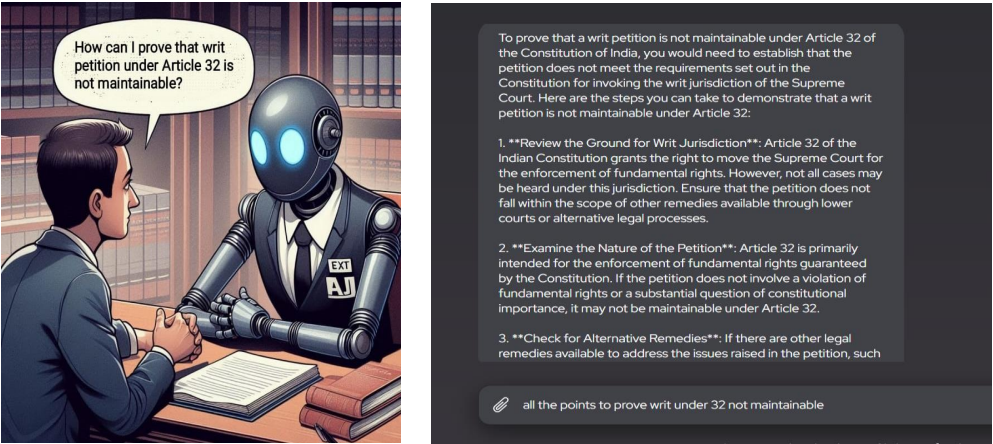
- AI Lawyer: The AI Lawyer tool provides instant legal help and document creation. It
automates legal research and paperwork. For example, if you ask a legal question, it
provides an answer, or if you need important clauses drafted for a contract, this tool can
do that as well.
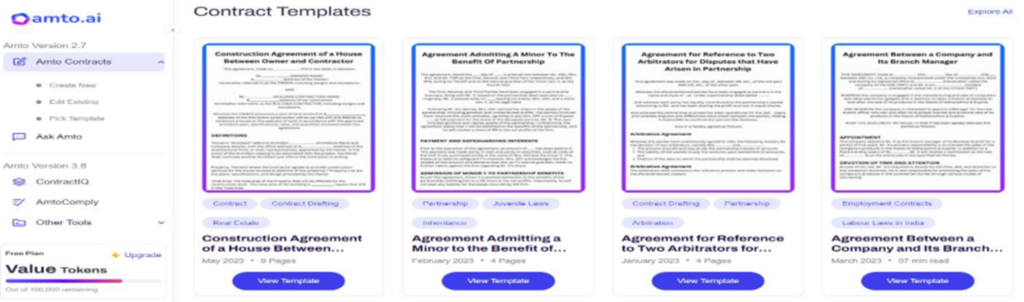
- Amto.ai: An AI tool that assists in drafting and updating legal documents consists of
various templates to choose from, and it can be customized according to our needs.
Additionally, it can work with existing legal documents to make necessary adjustments
based on our requirements.

- LawGeex AI: The Lawgeex AI-powered platform automates and accelerates contracting, allowing legal teams to focus on strategic issues. It offers rapid value with modules for contract lifecycle automation, including drafting, negotiation, extraction, and storage. Lawgeex uses contextual intelligence to understand legal language, accurately review contracts, enhance negotiations, and speed up approvals at scale.
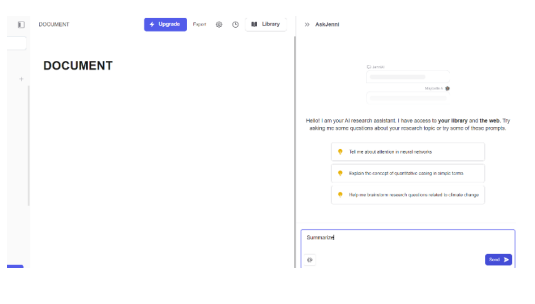
- JenniAI: Jenni AI is a tool that helps summarize lengthy documents. You provide the
document and ask Jenni to summarize it, and it will generate a summary along with an
analysis. Additionally, if you are writing a legal notice or any other document, Jenni AI
will offer writing suggestions to assist you.
- Unriddle: Unriddle is an AI tool that helps law students and lawyers summarize
judgments and other legal documents in PDF format into concise notes. Acting as a
research assistant, Unriddle uses advanced language models to streamline the research
process by offloading routine tasks. This allows users to quickly find insights in legal
literature, aiding in faster writing and analysis. This tool is particularly valuable for legal
professionals needing to condense complex judgments into manageable summaries.

- Fireflies.ai: Fireflies.ai is an AI tool designed for lawyers, offering accurate transcription,
summarization, search, and analysis of voice conversations, including public court arguments. It
transforms spoken words into text, provides concise summaries, and makes transcripts
searchable, enabling lawyers to quickly locate and reference key information. Additionally, its
analytical capabilities offer insights into discussions, aiding in case preparation and strategy.
- Chat GPT: ChatGPT is an invaluable tool for lawyers, offering multifaceted support in various
aspects of their practice. From legal research
to drafting documents, ChatGPT provides
quick access to relevant information and
assists in formulating arguments.
Conclusion
AI represents more than just a technological advancement; it signifies a fundamental shift in
how legal work is approached and conducted. For law students, embracing AI presents an
unprecedented opportunity to enhance their research, drafting, analytical, and practical skills.
As we’ve discussed various AI tools available for legal professionals, it’s evident that the
landscape of legal education and practice is evolving rapidly.y
With the multitude of AI tools available and more being developed, it is imperative for every
law student to learn and harness the power of AI to remain efficient and competitive in their
future careers. By integrating AI into their skill set, law students can not only streamline their
workflows but also stay abreast of technological advancements shaping the legal industry. In
this digital age, AI is undeniably a boon for law students, empowering them to thrive in a
dynamic and evolving legal landscape
By Rashi Mamar
Student of Amity Law School, Noida
During Summer Internship @ Aura and Company
India’s Premier and First eLaw Firm